Please click the button below⏩ to proceed with your registration.
📰 Introduction
Ischemic stroke remains a significant global health burden, ranking as the second leading cause of mortality worldwide and the primary cause of long-term disability[1]. Ultrasound (US) plays a pivotal role in the assessment of plaque morphology and the early identification of high-risk lesions.
Carotid plaques contribute to ischemic stroke through two primary mechanisms[2]:
- Progressive plaque growth leading to luminal stenosis.
- Plaque rupture triggering thromboembolic events.
Consequently, accurate evaluation of both plaque morphology and vulnerability is essential for effective stroke prevention and optimal clinical management. In this Challenge, our goal is to develop reliable artificial intelligence tools for automated plaque segmentation and vulnerability classification.
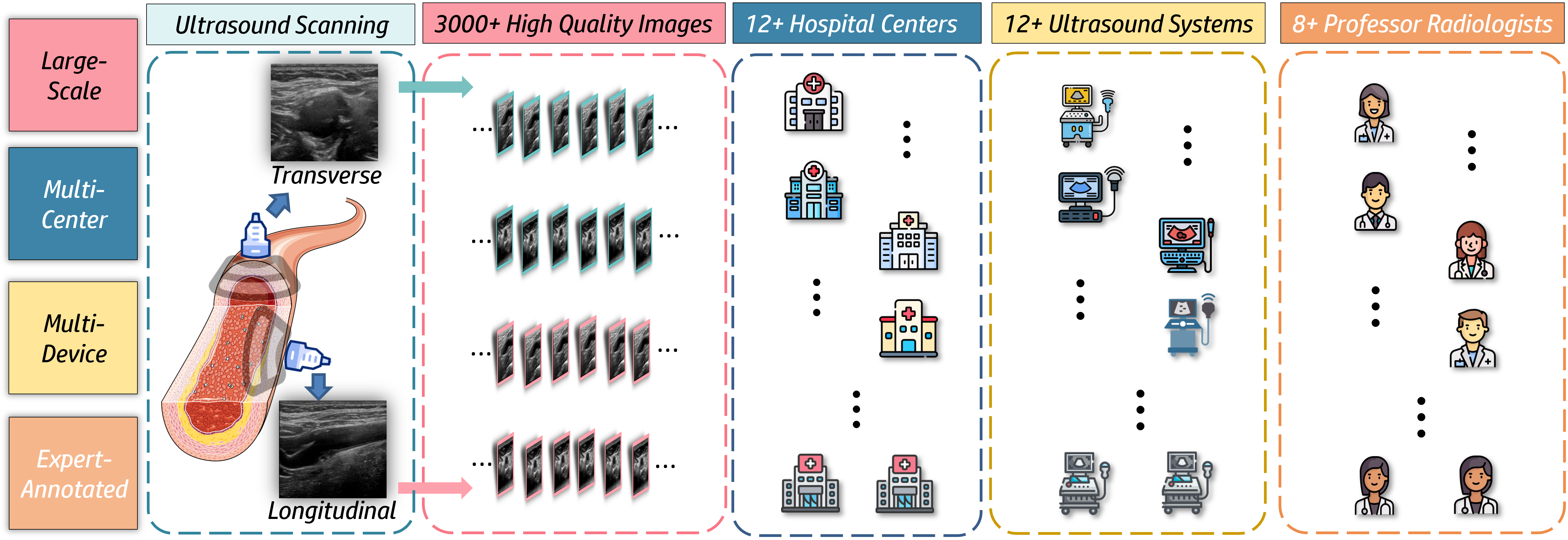
As shown in the figure above, we collected 1,500 paired carotid plaque US images from 12 hospitals across 12 different US systems, covering most machine types used in clinical practice. To our knowledge, this is the first large-scale, multi-center, multi-device carotid US dataset.
This Challenge is formulated as a semi-supervised segmentation + classification task. We randomly selected 10% of the data from the training set for detailed expert annotation. Each pair of data contains ultrasound (US) images from two views: longitudinal and transverse.
In annotation, each instance includes two view-level segmentation masks and one instance-level classification label. The segmentation masks are annotated by a team of five radiologists and subsequently reviewed by three senior radiologists to ensure quality. The instance-level classification label determined by three senior radiologists according to the International Plaque-RADS Guidelines[3] and categorized into low-risk (RADS 2) and high-risk (RADS 3-4).
🎯 Tasks
This Challenge aims to advance the development of intelligent algorithms for comprehensive carotid plaque assessment through US imaging. Participants are expected to develop robust and generalizable methods capable of:
- Segmenting Two view carotid plaque and vascular structures to enable automated quantification of luminal stenosis.
- Plaque vulnerability classification (low-risk vs. high-risk) to assess rupture risk.
These automated solutions are intended to improve diagnostic accuracy and consistency, support clinical decision-making, reduce inter-observer variability. By fostering innovation in AI-driven medical image analysis to promote the translation of advanced technologies into clinical practice and contribute to equitable stroke prevention worldwide.
✍️ Registration and Participation
The CSV 2026 Challenge is open to researchers, students and industrial teams interested in carotid plaque segmentation and vulnerability assessment in US. Both single-person and multi-person teams are welcomed. Please use the link below to access the CSV Challenge Platform and proceed with your registration:
We strongly recommend using Google Chrome or Microsoft Edge to access the platform, as these browsers are fully optimized for our registration system.
All participants should take note of the following points:
- The team contact person needs to use the institutional email address.
- Each team can only register once and is not allowed to participate repeatedly.
- Participants are required to submit a paper that details the research methods and results, with a length limit of no more than 5 pages.
- Promise to cite papers and data overview papers related to this Challenge when submitting the developed methods to scientific or non-scientific publications.
After your registration is approved, you will receive credentials to access the dataset download portal in CSV Challenge Platform. Further details are provided in the Challenge Rules and Policies
🧩 Dataset
Our dataset is a large-scale carotid ultrasound collection containing 1,500 paired cases, each consisting of longitudinal and transverse B-mode images. We provide 1,000 paired training cases, with 10% of them manually annotated to support model development. 200 cases are designated for the validation set, and 300 cases are used for testing.
The dataset is available through the CSV Challenge Platform. You can obtain the dataset by following the steps below:
- Visit the CSV Challenge Platform to download the Data Use Agreement.
- Confirm that you agree to all data usage rules. Participants who violate these rules may have their results disqualified by the organizers.
- Sign the agreement and send it to our official email: csv2026_challenge@163.com , then wait for approval.
If you have correctly completed the steps above and your application is approved, you will be granted permission to participate. We will send you the download link for the training data by official email. Under all circumstances, you must comply with the data usage rules in the Challenge Rules and Policies and must not share the dataset.
If you need to update your team information after registration, please contact the organizers via the e-mail address listed on the Contact Us page.
Dataset Structure
After downloading the dataset, you will obtain a training set with the following structure:
    train/
    ├── image/   # trainning images' file             001.h5/
    │   ├── 001.h5                                       ├──long_image # size: [512, 512, 1]
    │   ├── 002.h5                                       |    ↑_ # longitudinal B-mode image;
    │   ├── 003.h5                                       └──trans_image # size: [512, 512, 1]
    │   └── ...                                               ↑_ # transverse B-mode image;
    │
    ├── label/   # trainning labels' file         001_label.h5/
    │   ├── 001_label.h5                                 ├── long_mask # size: [512, 512]
    │   ├── 002_label.h5                                 |    ↑_ # longitudinal image's mask;
    │   ├── 003_label.h5                                 ├──trans_mask # size: [512, 512]
    │   └── ...                                          |    ↑_ # longitudinal image's mask;
    │                                                    └──label  # 0 or 1 0:low risk; 1: high risk
    └── train.txt  # trianning file's list
🎁 Awards and Prizes
Top 10 teams will receive a cash prize, with 🏅 certificates to be awarded by the organizers during the ISBI 2026 conference.
- 1st Place: USD 800
- 2nd Place: USD 500
- 3rd Place: USD 300
- 4th-10th Place: USD 100
Reference:
[1] GBD 2019 Stroke Collaborators. Global, regional, and national burden of stroke and its risk factors, 1990–2019: a systematic analysis for the Global Burden of Disease Study 2019[J]. The Lancet. Neurology, 2021, 20(10): 795.[2] Saba L, Saam T, Jäger H R, et al. Imaging biomarkers of vulnerable carotid plaques for stroke risk prediction and their potential clinical implications[J]. The Lancet Neurology, 2019, 18(6): 559-572.
[3] Saba L, Cau R, Murgia A, et al. Carotid plaque-RADS: a novel stroke risk classification system[J]. Cardiovascular Imaging, 2024, 17(1): 62-75.